

If you've spent any time on developer Twitter or Reddit, you've probably seen the same post recycled every few months. The headline is always some variation of "Ruby on Rails is dead." It's a tired take, and the 2026 hiring data tells a very different story. Rails is quietly having one of its strongest years in over a decade, fueled by a generation of profitable, lean SaaS startups that need product engineers who can ship fast. It's also propped up by enterprise platforms that have spent fifteen years compounding their Rails monoliths into mission-critical infrastructure.
If you're a junior developer trying to break into the industry, Rails is one of the most underrated bets you can make right now. The path is narrower than JavaScript, but the competition is also thinner. The companies hiring are some of the best-run engineering organizations in tech.
Here's what the entry-level Rails market actually looks like in 2026, which companies hire juniors, what they're looking for, and how much you can expect to earn.
Why Rails is Still a Smart Bet in 2026
Before diving into companies, it helps to understand why Rails has stuck around. The framework was released in 2005 by David Heinemeier Hansson and built on the principle of "convention over configuration," meaning developers spend less time wiring boilerplate and more time shipping features.
Twenty years later, that thesis has aged well. In 2026, founders are running leaner teams, capital is tighter, and the dominant hiring profile is the "product engineer," someone who can take a feature from database to UI without three handoffs. Rails, especially with the Hotwire front-end framework, is purpose-built for that workflow. A solo Rails developer can build a fast, modern, interactive web app without standing up a separate React team.
That's why the framework still powers a remarkable lineup of companies: Shopify, GitHub, Stripe, Airbnb, Basecamp, GitLab, Zendesk, Cookpad, Twitch, and Coinbase, among many others. Shopify alone runs one of the largest Rails monoliths on the planet, processing billions of dollars in transactions across its merchant base every year. You can frequently see Ruby roles posted across these kinds of companies on the DayOneJobs technology board.
Companies That Actively Hire Junior Rails Developers
Not every Rails-using company hires juniors. Some prefer to bring in experienced engineers and have them ramp up. But there's a healthy list of companies that genuinely invest in entry-level talent.
Shopify is the obvious starting point. The company runs an established intern and new-grad pipeline through its engineering careers page and hires what it calls "spiky generalists," engineers with a deep area of strength but broad enough to work across the stack. Shopify's stack is one of the most well-known Rails environments in the industry, and the company hires globally with a strong remote culture.
GitLab is another strong option for juniors, especially if you want fully remote work. GitLab is open-source and Rails-based, which means you can contribute to the codebase before you ever apply. That's one of the most reliable ways to stand out in a junior application.
Basecamp (37signals) is small but iconic. They're the literal birthplace of Rails and occasionally hire junior product engineers. Their bar is high, but a strong portfolio plus genuine alignment with their philosophy can get you in the door.
Zendesk, Gusto, Stripe, and Coinbase all run substantial Rails codebases and have new-grad and early-career programs in various regions. Stripe's hiring bar is famously high, but it does run university and bootcamp pipelines for engineering roles.
Mid-sized SaaS companies are often the best-kept secret. Companies like Aha!, Procore, ConvertKit, Honeybadger, Doximity, and many YC-backed Rails startups regularly post junior and mid-level Rails roles. These companies typically offer better mentorship and faster ownership than FAANG-tier employers, which matters enormously early in your career.
For active listings, the Rails Job Board (run by the official Ruby on Rails organization) and the monthly Hacker News "Who is Hiring?" thread are the highest-signal places to look. Ruby on Remote is another solid resource that filters specifically for remote Ruby and Rails roles by experience level.
What Hiring Managers Actually Look For
The 2026 junior Rails market has matured well past "you know rails generate scaffold." Hiring managers are looking for evidence that you understand how a modern Rails app is actually built and deployed.
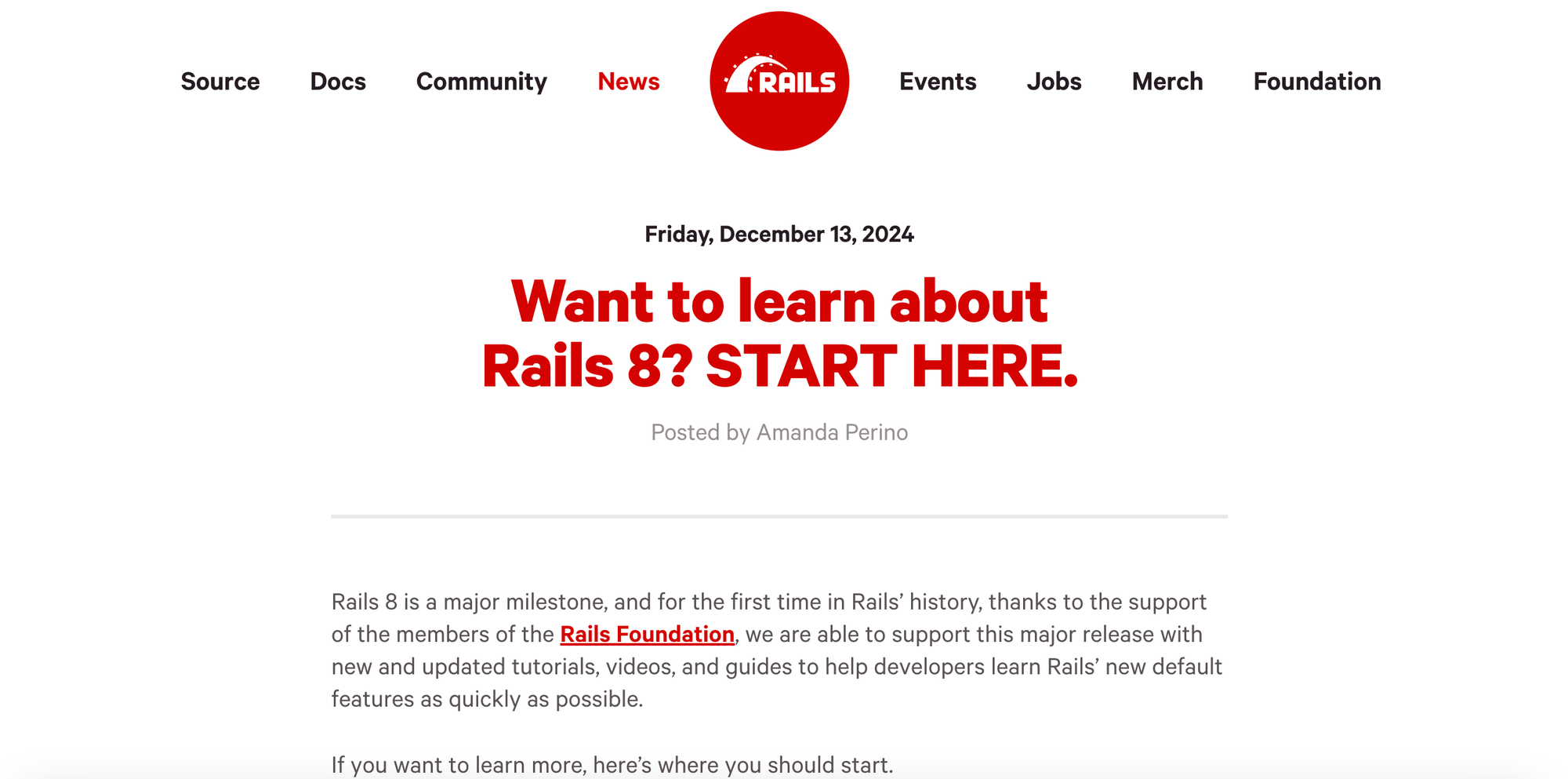
Rails 8 fundamentals. Rails 8 ships with major changes. Solid Queue replaces Redis-backed background jobs for many use cases, Solid Cache and Solid Cable round out the "no Redis required" stack, and Kamal 2 is the default deployment story. If you can talk fluently about these, you'll signal that you've actually been building with the framework recently.
Hotwire over heavy SPAs. Comfort with Turbo Frames, Turbo Streams, and Stimulus is increasingly the default expectation. Hiring managers want to see you can build dynamic UIs without reaching for React first.
Testing with RSpec or Minitest. Test-driven development is a deeply ingrained part of Rails culture. A junior who writes tests as part of their portfolio projects stands out immediately.
Git, PostgreSQL, and basic deployment. You should be able to manage a feature branch workflow, write reasonable SQL, and deploy a Rails app to a production environment such as Heroku, Render, Fly.io, or a VPS with Kamal.
Communication and code review etiquette. Rails teams are typically small and collaborative. Hiring managers consistently rank "writes clear PR descriptions and takes feedback well" above raw technical horsepower for junior hires.
The strongest junior candidates we see in the DayOneJobs candidate pool typically have one or two real Rails projects deployed to production with public URLs, an active GitHub showing consistent contribution, and at least one open-source contribution to a gem or Rails-adjacent project.
Salary Ranges for Junior Rails Developers in 2026
Compensation varies significantly by location and company tier, but the data points to a healthy market. According to ZipRecruiter's salary data as of April 2026, junior Ruby on Rails developers in the United States earn an average of $122,113, with most workers in the role making between $102,500 and $140,500 depending on experience, location, and employer. Junior Ruby developers more broadly average around $88,976, with the typical range running from $67,000 to $87,000.
Those numbers reflect a few realities. First, Rails skews toward more experienced developers, which pulls the "junior" average upward. Many companies hiring "junior" Rails devs are really looking for someone with 1 to 2 years of experience rather than a true zero-experience hire. Second, fully remote roles at well-funded SaaS companies tend to pay at the higher end of the range, while contract and agency work tends to fall in the middle.
Outside the US, salaries for remote Rails roles with US or UK companies typically run €50,000 to €85,000 in Europe and somewhat lower in regions like Latin America and South Asia, though the gap has narrowed significantly in the post-2024 remote era.
For a more detailed breakdown of developer compensation across roles, frameworks, and seniority levels, InterviewPal's salaries database maintains current ranges across the major engineering tracks.
How to Land Your First Rails Job
Three concrete moves separate juniors who get hired from juniors who don't.
Build and deploy a real project. Not a tutorial clone, but an actual application that solves a small, real problem. Deploy it. Put the URL on your resume. The single biggest signal a junior can send is "I can ship working software," and a deployed project is the cleanest possible proof.
Contribute to open source. Rails itself, popular gems, or any well-maintained Rails app on GitHub. Even small documentation PRs build credibility. Hiring managers regularly say they hire from their open-source contributors before they hire from cold applications.
Apply to mid-sized companies, not just the famous ones. Everyone applies to Shopify and Stripe. Far fewer people apply to the 200-person Rails-shop SaaS company that desperately needs a junior backend developer. Use job boards that surface these. The Rails Job Board, Hacker News Hiring, and DayOneJobs are all designed to surface entry-level roles you won't see on LinkedIn's front page.
The Rails ecosystem has a reputation for being one of the friendliest, most welcoming developer communities in tech, and that extends to hiring. Conferences like RailsConf, RubyKaigi, and the regional Ruby meetups are unusually approachable for juniors. Maintainers respond to thoughtful first-time contributors. The community Slack and Discord channels actually answer questions instead of pointing you at the docs. If you're coming from a less established ecosystem, the difference in tone is striking, and it shows up in hiring too. People remember the juniors they helped, and warm introductions still drive a meaningful share of Rails hires.
Show up with a deployed project, a GitHub that demonstrates you're actively learning, a couple of open-source contributions however small, and the patience to apply to the right size of company. The path in is genuinely open. Most juniors who fail to break in fail because they apply to twenty FAANG-tier companies and give up, not because the market rejected them. The market for junior Rails devs at 50-to-500 person SaaS companies is wide open if you actually look there.
The framework isn't dying. It has just gotten quieter, more profitable, and more selective about the people it lets in. The companies running on Rails today are largely the ones that survived the 2022-2024 funding crunch by staying lean, shipping fast, and hiring well. They're not chasing trends, they're compounding. That's exactly the kind of company you want to start your career at: stable enough to invest in mentoring you, small enough that you'll ship real features in your first month, and selective enough that the people you'll be learning from are genuinely good at their jobs. That's a market worth competing in.